If you’re keeping your vehicle past 80,000 km, running two sets of tires just makes sense. All-seasons wear faster year-round, while splitting use between winters and all-seasons helps each set last longer, saving you money over time.
Better braking distance. In icy conditions, winter tires stop 34% faster than all-season tires
›
Enhanced traction in snow, rain & cold weather. Winter tires have better traction in snowy conditions, especially when temperatures dip below zero.
›
Tighter-controlled cornering. In icy/cold conditions, winter tires allow for more precise, 90-degree turns.
›
Superior in soggy conditions. Winter tires' deeper tread design allows for better drainage, countering the "aquaplaning" effect that can occur when driving through large puddles.
›
Timing is everything. When temperatures consistently hit below 7°C, you know it's time to change to winter tires.
Audi Genuine Winter Wheels versus Aftermarket
›
Most aftermarket tires do not match the same safety or performance specs that Audi Tires must comply with. They are made to fit many different vehicles, they will likely not match the exact specifications needed to fit your vehicle.
›
Every Audi needs the perfect pair of tires. Matching the tire to the top speed and loading requirement of your vehicle will ensure enhanced traction, handling and safety. When your vehicle isn't fitted with the proper tires, performance suffers, reducing traction, handling and control.
›
Audi has built its legacy on uncompromising design, engineering, and performance. You and your Audi vehicle deserve winter tires that deliver on those same guiding principles. Designed with each unique Audi vehicle in mind, Audi Genuine Winter Tires & Wheels work in perfect harmony with your vehicle to ensure the perfect fit, optimal performance, and of course, striking design.
›
To ensure your Audi is equipped with the right tires, Audi Durham can help provide you with the proper recommendation that meets your Audi's needs perfectly.
What is the difference between winter tires and all-season tires?
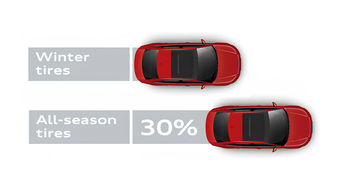
On dry pavement, with temperatures just below freezing, the stopping distance for vehicles equipped with all-season tires is 30% longer than for vehicles equipped with winter tires.
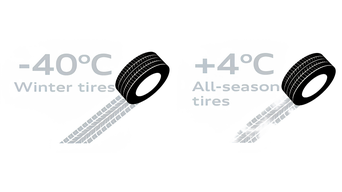
Winter tires also have better traction on a snowy surface
At temperatures of -40°C than all-season tires have at +4°C. (Mahler 2008a). Even on dry pavement, the overall performance of an all-season tire declines as the temperature becomes colder. (Fountain Tire 2011)